

Getting on and off a low toilet can become one of the most tiring and worrisome moments in a senior’s daily routine, especially after a hospital stay or when balance feels less steady. Caregivers often look for a simple aid that may help reduce the risk of slips without a full bathroom remodel.
This Vive toilet safety rails review for elderly focuses on one product, the Vive Toilet Safety Rail with Arms, and what its spec sheet and caregiver-reported details suggest about everyday use. Always check with a physician, occupational therapist, or healthcare provider before making mobility changes for a senior in your care, and read on for strengths, limits, and who it suits best.
This guide contains affiliate links, and we may earn a commission if you buy through them, at no extra cost to you.

Prime Vive Toilet Safety Rail with Arms


As an Amazon Associate we earn from qualifying purchases. Product prices and availability are accurate as of the date/time indicated.
What Stands Out
Based on the manufacturer’s specifications and description, four details stand out for older adults who want steady support without permanent installation.
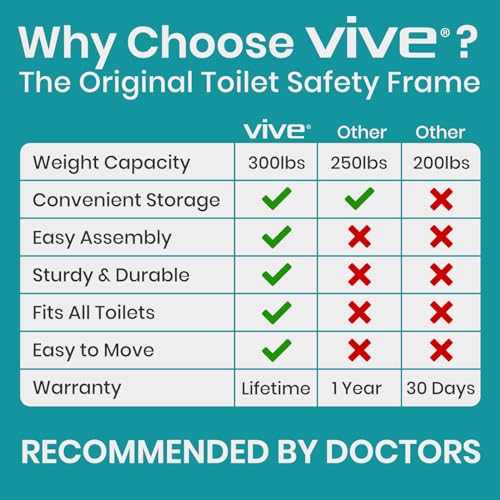
Stand-Alone Frame Rated to Support Up to 300 Pounds
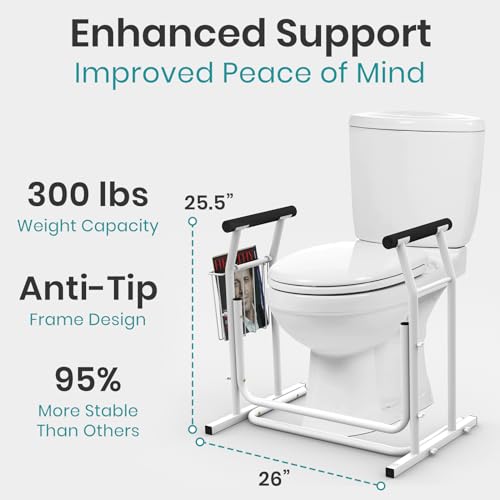
The frame is rated to support up to 300 pounds, which covers a wide range of users seeking extra stability when sitting or standing. The rating comes directly from the product specifications and reflects the sturdy construction described by the maker.
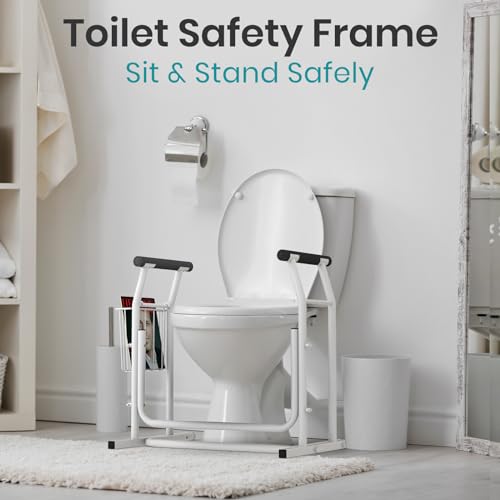
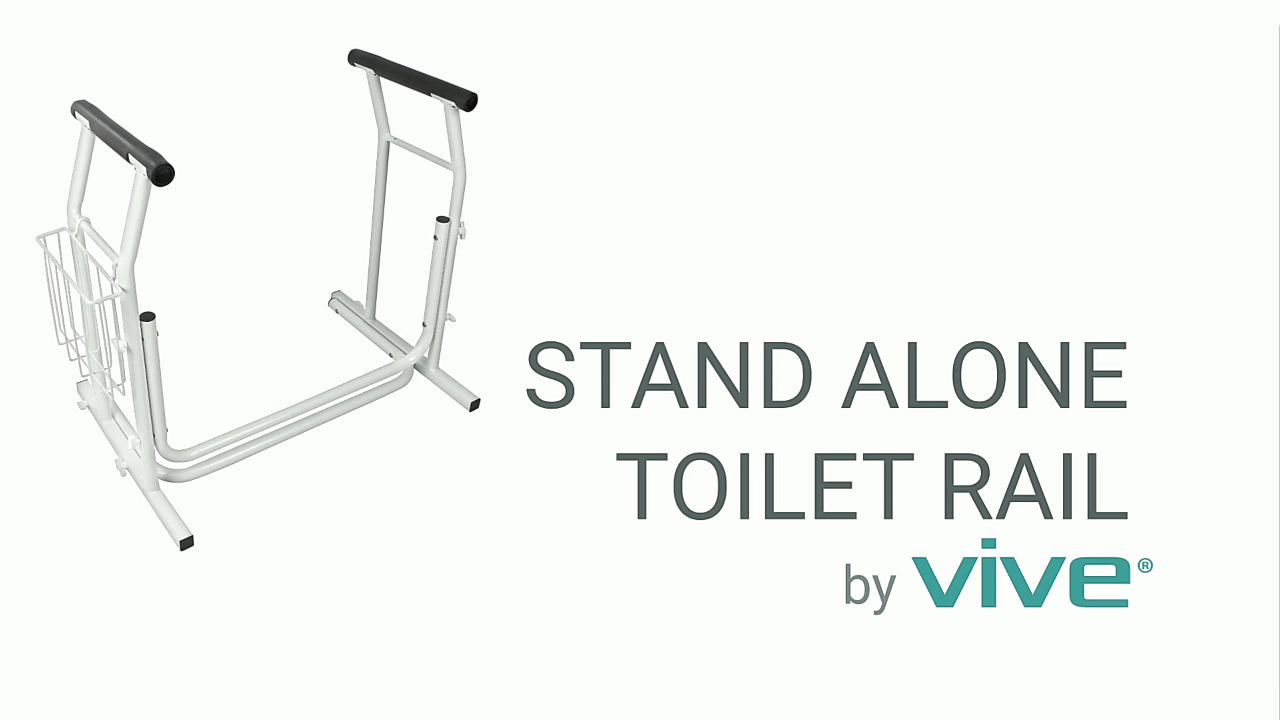
Unlike wall-mounted bars, this is a stand-alone lifter that surrounds the toilet with two side arms. That layout lets you push evenly with both hands, which many seniors find more intuitive than reaching to one side.
The arms are positioned to provide leverage at a natural height for most adults, which may help make the sit-to-stand motion feel more controlled. For caregivers, the bilateral support can mean less need to provide hands-on lifting during bathroom visits.
The frame is described as a support aid, not a medical device, and it does not replace professional guidance for significant mobility loss. It is designed to supplement balance and confidence during a routine task while encouraging independence.
If you are comparing options in the broader Toilet Safety & Commodes category, this weight rating puts it in the standard-duty range for freestanding rails. Households needing higher capacity may want to review bariatric alternatives that are rated for greater loads.
Tool-Free Assembly Designed for Quick Setup
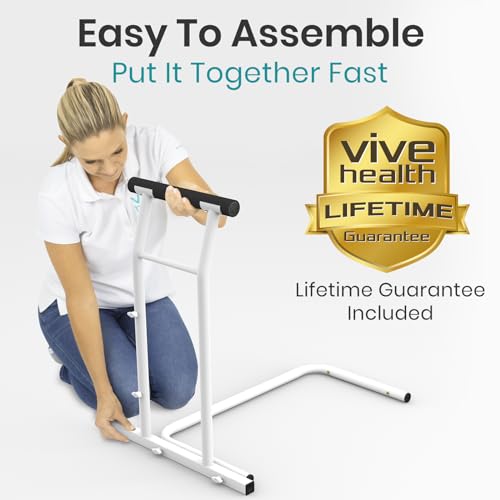
The maker highlights a simple, tool-free assembly process that can be completed in minutes. That approach is helpful for families who need a quick solution after discharge or for a short-term recovery period at home.
Because no drilling or cementing is required, the rail can be placed and later removed without modifying walls or flooring. This is useful for renters or for shared homes where permanent changes are not practical or allowed.
Setup relies on fitting the frame around the existing toilet rather than anchoring into studs. Caregivers commonly report that clear instructions and fewer parts make the process less stressful, though following the included guide step by step remains important for proper fit.
The quick-setup design also means the rail can be moved if the senior relocates between a bedroom and bathroom setup. For those also considering a bedside commode for knee replacement, a portable toilet rail offers a complementary option for the main bathroom.
As with any freestanding aid, stability depends on correct assembly and placement on a level floor. Checking that all connections are secure before each use may help reduce the risk of wobbling and support more confident daily use.
Padded, Non-Slip Handles for a Comfortable Grip
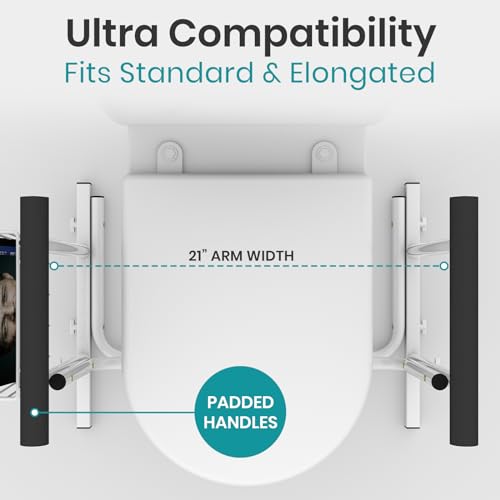
The handles feature soft, padded foam with a textured surface intended to provide a secure grip. For older hands, especially those with reduced grip strength, a cushioned surface can feel more comfortable than bare metal.
The padding also helps reduce pressure on the palms during the pushing motion. That small comfort detail matters when the rail is used multiple times each day and night.
Textured covering is designed to limit slipping, even if hands are slightly damp. While no handle can remove all risk, a non-slip surface may help support a steadier hold throughout the movement.
The armrests run along the sides at a length that allows different hand positions. Seniors who need to adjust their grip as they rise can find a spot that feels most supportive without overreaching.
If you are exploring other bathroom supports, the sibling collection at Grab Bars & Rails shows how padded rails compare to wall-mounted bars for shared bathrooms. The choice often comes down to whether you prefer a freestanding or permanently installed solution for your space.
Compact Design That Works With Most Standard Toilets
The rail is described as a stand-alone lifter that does not require removing or replacing the existing toilet seat. That keeps the bathroom looking familiar, which many seniors prefer over a commode-style change.
It is intended to fit around most standard toilets, sitting on the floor and framing the bowl. The compact footprint is meant to work in smaller bathrooms where a bulky commode would be in the way.
Because it does not elevate the seat itself, the rail preserves the normal toilet height. Seniors who do not need a raised seat but do need arm support may find this balance helpful for maintaining a natural posture.
For households weighing a raised option, our guide to the best raised toilet seat for low vision seniors reviewed explains when added height is useful and when side support alone is enough for safe transfers.
Compatibility still depends on toilet shape and bathroom layout, so measuring the space around the bowl before ordering is wise. The product description notes that checking dimensions helps confirm a proper fit and avoids crowding the area.
Where It Comes Up Short
No single rail solves every bathroom layout, and this model has trade-offs to consider. As a freestanding frame, it relies on floor contact and correct positioning rather than wall anchors, so it may shift if not placed on a flat, non-slip surface or if the user pulls unevenly on one arm. Caregivers should plan to check placement regularly and to remind users to apply even pressure with both hands.
It also does not raise the seat height, so seniors who struggle most with a very low toilet may still need a separate riser to reduce the distance to stand. Finally, while it is described as fitting most standard toilets, homes with unusually narrow spaces, curved tanks, or nonstandard bowls should verify measurements, as the frame needs clearance on both sides to sit evenly and provide balanced support.
Who Should Buy This
This rail may be a good match for a senior who can still bear weight and stand with some assistance but wants steady arm support to make the motion feel more secure, and for a caregiver who needs a portable, tool-free option that can be set up quickly without altering the bathroom. It also suits shared households where a permanent grab bar is not desired, where the existing toilet height is already comfortable, and where a compact, removable aid that may help reduce the risk of unsteadiness is preferred over a full commode.
Who Should Skip It
This option is not ideal for seniors who need bariatric-level support above its 300 pound rating or who require a fully wall-anchored system for maximum stability. If a clinician has recommended a permanently installed grab bar or a raised seat with locking mechanisms, a stand-alone rail alone may not provide the level of support needed for safe transfers.
It is also not the right choice for very compact bathrooms where there is not enough side clearance for the frame to sit level, or for toilets with curved or irregular tanks that interfere with placement. In those layouts, a different style, such as a bolted frame or a wall-mounted solution explored in our Bathroom Safety hub, may be more appropriate and less prone to shifting.
Households looking for a single product that both raises the seat and provides arms should skip this model and consider a different category. This rail is designed to add handles, not height, so pairing it with a separate riser would be necessary if elevation is the primary goal for reducing strain on knees and hips.
Frequently Asked Questions
Does the Vive Toilet Safety Rail with Arms fit elongated toilets?
According to the product description, the stand-alone frame is designed to surround most standard and elongated toilets without removing the seat. Fit depends on the space around the bowl and a level floor, so measuring width and depth before ordering is recommended. If your toilet has an unusual shape or a curved tank, confirming clearance on both sides will help avoid a poor fit.
Is the Vive Toilet Safety Rail with Arms stable without wall mounting?
The frame is freestanding and gains stability from its floor-standing design and correct assembly, rather than from wall anchors. When placed on a flat, non-slip surface and used with even pressure on both arms, it may help reduce the risk of unsteadiness during transfers. It should be checked for secure connections before each use and is not a substitute for a wall-anchored bar when a clinician recommends one.
Do you need tools to assemble the Vive Toilet Safety Rail with Arms?
The maker states that assembly is tool-free and can be completed in minutes with the included components. No drilling or permanent hardware is required, which makes it suitable for temporary or rental situations. Following the step-by-step guide ensures all parts are locked in place for everyday use.
Browse more picks in our Toilet Safety & Commodes category, or see our related guide on Toilet Safety Rails vs Cameras for Seniors in 2026.







Write Your Review
No reviews yet. Be the first to share your experience!