

Managing several prescriptions each day can become a source of worry for older adults who want to remain at home and for the family members who support them. Missed doses, double doses, and confusion about which pills to take at which time are common concerns, especially when vision, memory, or dexterity changes.
This Medline smart pill dispenser with alarm review for elderly focuses on one specific product, the
This guide contains affiliate links, and we may earn a commission if you buy through them, at no extra cost to you.

Prime Betife Automatic Pill Dispenser


As an Amazon Associate we earn from qualifying purchases. Product prices and availability are accurate as of the date/time indicated.
listed as the Betife Automatic Pill Dispenser,28-Day. The review is grounded in the product’s published specifications and description, not hands-on use, to help you decide if its monthly capacity, Bluetooth app, and alarm system match your household’s needs in 2026.Prime Betife Automatic Pill Dispenser
As an Amazon Associate we earn from qualifying purchases. Product prices and availability are accurate as of the date/time indicated.
What Stands Out
The Betife Automatic Pill Dispenser,28-Day is presented as a monthly timer dispenser with app support and reminder alerts. The following strengths are drawn directly from its listing details and may matter most for aging-in-place planning.
28-Day Capacity for Monthly Planning
The dispenser is organized around a 28-day supply with individual compartments intended for once-daily dosing. For seniors who take a consistent set of pills at the same time each day, this layout may help reduce the frequency of refills and sorting.
Having a full month prepared at once can support a calmer routine for caregivers who visit weekly or monthly. Instead of refilling a weekly box every few days, you can set up the month and then rely on the device’s alerts to prompt each dose.
The monthly approach also creates a clearer visual record of adherence. If a compartment remains full when it should be empty, it signals a missed dose that can be addressed promptly with a phone check-in or visit.
The compartments are described as large enough for pills, tablets, and capsules, which may help if you manage multiple vitamins or generic tablets together. This can be useful when a standard seven-day organizer feels too small or requires frequent handling.
For households that already use other Kitchen Adaptive Tools to simplify daily tasks, a monthly dispenser fits the same goal of reducing repetitive fine-motor work. Less frequent loading means fewer opportunities for sorting errors.
The 28-day structure is most helpful when prescriptions are stable. If your physician changes dosages often, you will need to update the compartments to match the new schedule, so plan refill days around appointments.
Bluetooth App Support for Family Oversight
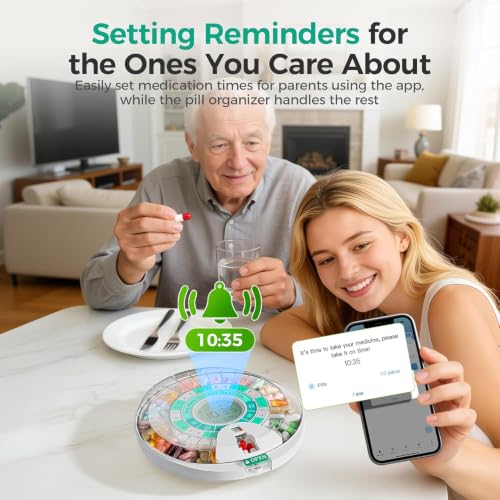
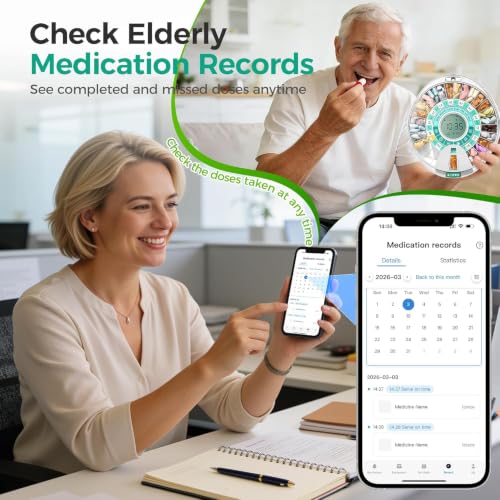
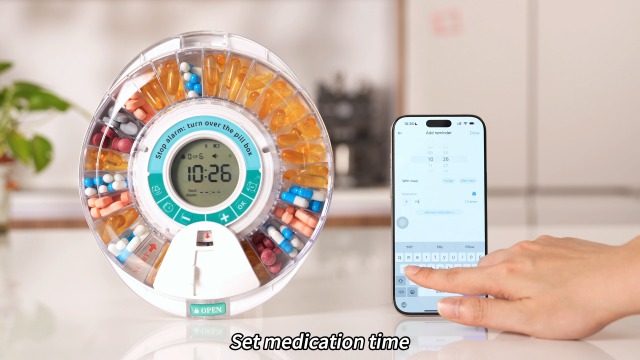
This model includes Smart Bluetooth Control with an app for medication alarms, history, custom names and images, and tracking statistics. The listing highlights easy setup through the app, which is designed to let family members configure reminders without complex programming on the device itself.
App support may help reduce the risk of missed doses by allowing caregivers to set personalized schedules and labels. Custom names and images can make it clearer which compartment corresponds to which time, especially for seniors with low vision or memory concerns.
The history and tracking features are positioned as a way to monitor adherence over time. Rather than relying on memory, caregivers can review whether doses were accessed as scheduled and follow up with supportive reminders.
Bluetooth connectivity is intended for short-range management at home, not for continuous remote monitoring over the internet. This setup may suit families who set up the device during visits and then rely on the dispenser’s built-in alarms for day-to-day prompting.
If you are comparing app-supported options to simpler organizers, consider how comfortable the primary user is with smartphones. The app is optional for daily use once alarms are set, so the senior does not need to interact with the phone to receive reminders.
For caregivers who also help with other daily living tasks, pairing a connected dispenser with low-tech supports can be practical. For example, many families combine medication reminders with tools like the button hooks for stroke recovery to support broader independence without adding complexity.
Six Alarms with Light Reminders
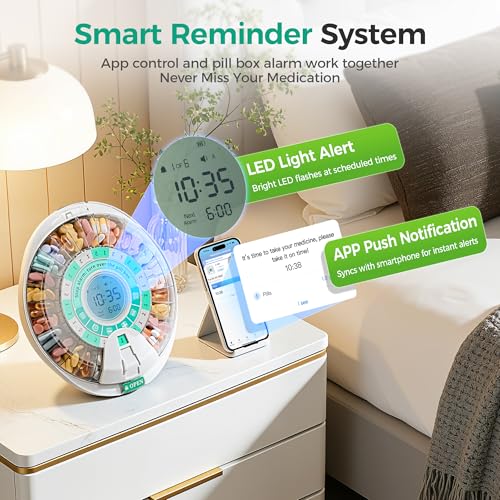
The product is described as offering six alarms with both sound and light reminders. Multiple alarm times can accommodate seniors who take medications morning, midday, evening, or at bedtime, without needing separate timers.
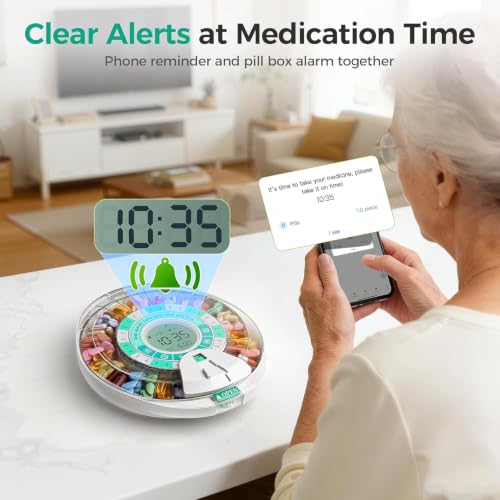
Sound alerts draw attention even if the dispenser is in another room, while light cues provide a visual prompt for those with hearing changes. Together, the dual signals may help reduce the chance that a reminder is overlooked during daily activities.
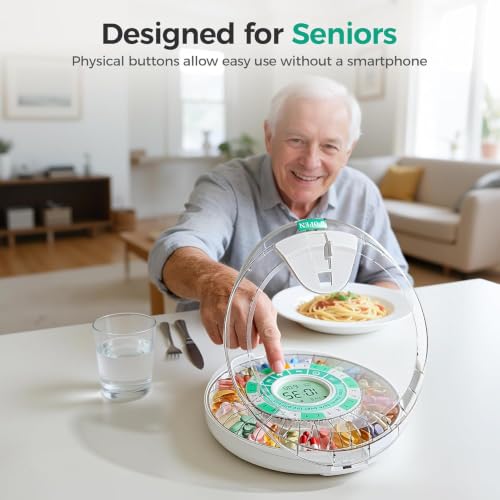
The listing also notes an electronic, one-press dispensing action. For older adults with arthritis or limited hand strength, a single press can be easier than twisting caps or opening many small lids each day.
Consistent alarm timing supports habit formation. When reminders occur at the same times daily, they can anchor medication routines to meals or other regular events, which many caregivers find helpful for adherence.
It is important to place the dispenser where alerts will be noticed but not disruptive. A kitchen counter or bedside table within sight and hearing range often works better than a closed cabinet.
If you are exploring other supports for daily safety and visibility, you may also find guidance in best kitchen reacher tools for seniors with arthritis, which covers tools that reduce reaching and bending during routine tasks.
Easy Setup and Senior-Friendly Design Details
The listing emphasizes easy setup, which is a key consideration for households where the senior lives alone or where caregivers have limited time to program devices. Clear setup steps may help reduce errors when entering alarm times and compartment assignments.
The dispenser’s monthly timer approach is intended to simplify management compared with multiple weekly boxes. Fewer containers to track can mean fewer chances for confusion, especially when more than one person helps with refills.
Described as an electronic medication management system, the device is meant to supplement, not replace, a written medication list. Keeping an updated list from your pharmacist near the dispenser remains a good practice for reference and for medical appointments.
For seniors who prefer straightforward tools, the combination of on-device alerts and optional app configuration offers flexibility. You can rely on the basic alarm and light functions daily and use the app mainly for initial setup and occasional review.
Households that prioritize stability may appreciate that the dispenser focuses on scheduled dispensing rather than complex features. This restraint can make the routine easier to explain to visiting family or home aides.
If balance or grip is a concern during kitchen routines, exploring related aids such as the best jar opener for seniors with balance issues can complement a medication system by making meal preparation safer and less strenuous.
Where It Comes Up Short
While the 28-day, once-daily format is convenient for many, it is less flexible for complex regimens that require multiple doses per day at different times or frequent dose changes. The six alarms help, but households needing several distinct dosing windows daily may need to confirm that a single monthly tray aligns with their prescription schedule.
Bluetooth app control is helpful for setup and tracking, yet it depends on a nearby smartphone and basic comfort with app navigation. Families who want continuous remote alerts over Wi-Fi or cellular networks may find Bluetooth alone limited, since it is designed for local configuration and history review rather than real-time distant monitoring.
The listing does not detail a locking mechanism or overdose prevention feature for this specific model, unlike some dispensers that highlight key locks or fingerprint locks. If securing medications from accidental double-dosing or access by others is a priority, you will want to verify what safeguards are included before choosing.
Large compartments are useful for multiple pills, but they also require careful loading to avoid mixing medications intended for different days. A clear, well-lit workspace and a second-person check during refill day can help keep the monthly load accurate.
Finally, any electronic dispenser relies on power and correct programming. It is wise to keep a backup reminder, such as a written schedule or phone alarm, and to review alarm settings after travel, power interruptions, or medication changes.
Who Should Buy This
This dispenser may be a good fit for older adults who take a stable set of medications once daily and want a simple monthly system with audible and visual prompts. It may also suit caregivers who visit periodically and prefer to set up a month at once, then rely on alarms and occasional app review to support adherence.
Households where a family member is comfortable with a smartphone app for initial setup may get the most value. The ability to label compartments with custom names or images and to review history can make coordination among siblings or aides more transparent.
Seniors with mild forgetfulness who respond well to sound and light cues often appreciate a single, consistent reminder source. Placing the dispenser in a central, everyday location can turn the alarm into a natural part of the morning or evening routine.
If your goal in 2026 is to reduce daily sorting and to create a more predictable medication workflow without adding many new devices, this monthly, app-supported model aligns with that priority. Pairing it with a current medication list and regular pharmacist review helps keep the system accurate.
Who Should Skip It
This product is not ideal for seniors who need multiple, widely spaced doses per day with different pill combinations at each time, since the 28-day single-tray layout is organized around a once-daily pattern. If your regimen involves three or four distinct dosing windows with varying pills, a multi-tray or multi-compartment-per-day system may be more appropriate.
It is also not a good fit for households that require a locked, tamper-resistant dispenser or continuous remote monitoring over the internet. Families seeking a key lock, fingerprint lock, or Wi-Fi alerts for real-time oversight should verify those features specifically, as this model’s description centers on Bluetooth app support and local alarms.
Seniors who are uncomfortable with any app setup and do not have a caregiver available to program alarms might prefer a simpler, no-app dispenser with on-device buttons and a basic alarm. In that case, choosing a model that emphasizes on-device setup alone could reduce frustration.
If medications change frequently or include complex instructions such as alternating-day dosing, skip this monthly format until the regimen stabilizes. Frequent changes increase the need to reload and reprogram, which can offset the convenience of a 28-day supply.
Frequently Asked Questions
How does the Betife Automatic Pill Dispenser,28-Day remind seniors to take their medication?
According to the listing, the dispenser provides up to six alarms with sound and light reminders to prompt each dose. The one-press dispensing action is intended to make access straightforward when the alarm signals, and the app can be used to customize alarm times and labels.
For best results, place the device where both the sound and light will be noticed during daily activities. Keeping a consistent location helps the reminder become part of the established routine.
Does this dispenser require a smartphone app to work each day?
The app is described as a support tool for easy setup, custom names and images, history review, and tracking statistics via Bluetooth. Once alarms are configured, daily reminders rely on the dispenser’s built-in sound and light alerts, so the senior does not need to open the app to take a dose.
Caregivers who are comfortable with smartphones can handle initial programming and periodic review, while the older adult interacts mainly with the dispenser itself. This division can keep daily use simple.
Is the 28-day format suitable for caregivers who manage medications for a loved one?
The 28-day capacity is designed to allow caregivers to load a full month at once, which may help reduce weekly sorting and provide a clear view of adherence. Large compartments are intended to hold multiple pills, tablets, or capsules per day, which suits stable, once-daily regimens.
If the care recipient’s prescriptions change often or require several different dosing times per day, confirm that a single daily compartment matches the schedule. For broader daily living support, you can also explore related resources in Kitchen & Daily Living for complementary adaptive tools.
Browse more picks in our Kitchen Adaptive Tools category, or see our related guide on Kitchen Reacher Tools for Arthritic Hands in 2026.









Write Your Review
No reviews yet. Be the first to share your experience!